Florence Nightingale

A Letter to the Workmen of Newcastle-on-Tyne

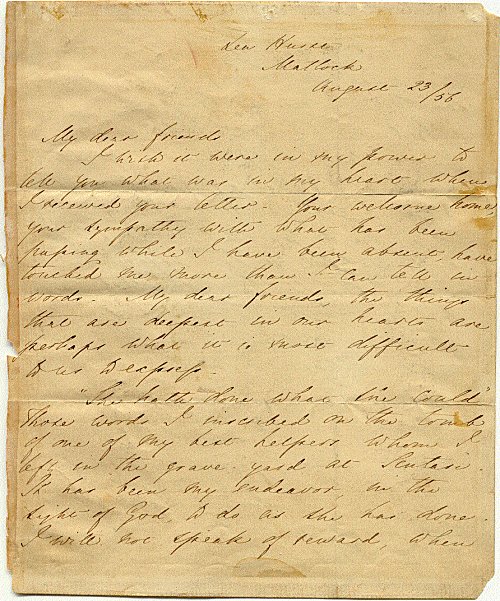
Original letter

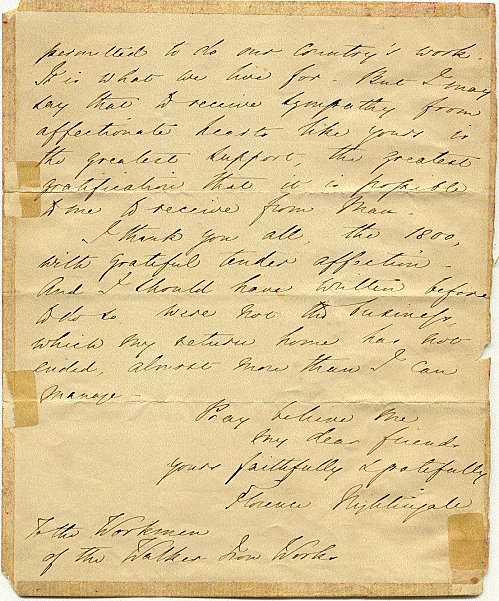
Original letter

From The Life of Florence Nightingale by Sarah Tooley:
Letters of congratulations and expressions of esteem from all sorts and conditions of people poured in upon Miss Nightingale after it was known that she was settled in her Derbyshire home, and public associations and societies sent deputations. If Florence Nightingale could have been persuaded to hold a reception, it would have been attended by delegates from every representative body in the kingdom; but while such a national appreciation of her labours was very gratifying to our heroine, her chief desire now was to escape publicity, and her enfeebled health made quietude a necessity.

She was specially pleased by an address sent by the workmen of Newcastle-on-Tyne, and replied in the following beautiful letter:

Lea Hurst
Matlock , England
August 23/56

My dear friends
I wish it were in my power to tell you what was in my heart when I received your letter. Your welcome home, your sympathy with what had been happening while I have been absent, have touched me more than I can tell in words. May dear friends, the things that are deepest in our hearts are perhaps what is most difficult to us.

"She hath done what she could" those words I inscribe on the tomb of one of my best helpers whom I left in the grave yard at Scutari. It has been my endeavor in the sight of God to do as she has done. I will not speak of reward. When permitted to do our country's work it is what we live for. But I may say that I receive sympathy from affectionate hearts like yours is the greatest support, the greatest gratification that it is possible of me to receive from man.

I thank you all, the 1800, with grateful tender affection -- and I should have written before I do so -- were not the business which my return home has not ended, almost more than I can manage.

Pray believe me
My dear friends
Yours faith fully and gratefully,

Florence Nightingale

The original letter shown here was recovered from the discarded scrapbook of Edward W. Bok by Stanley Lomas in 1910, when he was ten years old, riding his bike one day in Philadelphia.

Edward William Bok was born in Den Helder, Holland, on 9th October, 1863. When Bok was seven years old his family emigrated to the United States. After attending school in Brooklyn, New York City, Bok found work as an office boy at the Western Union Telegraph Company.

Bok had a strong desire to become a journalist and managed to get some of his work published in the Brooklyn Eagle. He continued his education at night school and in 1887 became advertising manager of the Scribner's Magazine. Two years later he became editor of the Ladies' Home Journal. Bok used the magazine to campaign for women's suffrage, pacifism, conservation of the environment and improved local government. By 1900 it was the best selling magazine in the United States.

Bok retired from the Ladies' Home Journal in 1919. His autobiography, The Americanization of Edward Bok (1920) was a best-seller and won a Pulitzer Prize. He also helped to fund the $100,000 American Peace prize. Edward Bok died in Tucson, Arizona, on 9th January, 1930.

From The Americanization of Edward Bok, an autobiography written in the third person:.

Edward Bok’s next quest was to be even more disappointing; he was never even to reach the presence of the person he sought. This was Florence Nightingale, the Crimean nurse. Bok was desirous of securing her own story of her experiences, but on every hand he found an unwillingness even to take him to her house. “No use,” said everybody. “She won’t see any one. Hates publicity and all that sort of thing, and shuns the public.” Nevertheless, the editor journeyed to the famous nurse’s home on South Street, in the West End of London, only to be told that “Miss Nightingale never receives strangers.”

“But I am not a stranger,” insisted the editor. “I am one of her friends from America. Please take my card to her.”

This mollified the faithful secretary, but the word instantly came back that Miss Nightingale was not receiving any one that day. Bok wrote her a letter asking for an appointment, which was never answered. Then he wrote another, took it personally to the house, and awaited an answer, only to receive the message that “Miss Nightingale says there is no answer to the letter.”


Home